Vendor Agnosticism: The Freedom to Swap Providers Without Breaking Your Workflow
Vendor agnosticism gives title agencies the operational freedom to swap backup abstractors and payment rails without breaking their core settlement workflow. In a high-stakes closing environment, reliance on a single, hardcoded vendor pipeline exposes escrow teams to severe operational bottlenecks when a primary provider experiences downtime or a sudden backlog. Decoupling your Title Production System (TPS) from external utilities mitigates integration debt, replacing rigid single-point failures with plug-and-play operational resilience.
This structural rigidity exposes agencies to severe integration debt. According to enterprise architecture research, organizations that rely on hardcoded, point-to-point software connections accumulate operational friction that slows digital transformation velocity by up to 30% [1]. To maintain agility, forward-thinking title leaders must decouple their core Title Production System (TPS) from external utilities through true vendor agnosticism.
Islands of Excellence vs. Orchestrated Adaptability
Every title agency relies on specialized partners—abstractors for title search, payment rails for earnest money deposits (EMD), eSignature platforms, and wire fraud detection tools. Individually, these applications represent high-value Islands of Excellence. However, when these utilities lack native orchestration with your system of record, your escrow staff is forced to manually carry data across disconnected browser tabs.
This manual gap creates a voluntary Swivel Chair Tax and Toggle Tax on your team’s productivity. Industry metrics reveal that unintegrated vendor handoffs contribute to an average 15% surge in operational turnaround delays and heightened processing error rates [2]. When a backup vendor must be introduced during volume surges, forcing processors to learn a completely new portal interface destroys operational momentum and exacerbates portal fatigue.
Plug-and-Play Resilience across the Digital Property Line
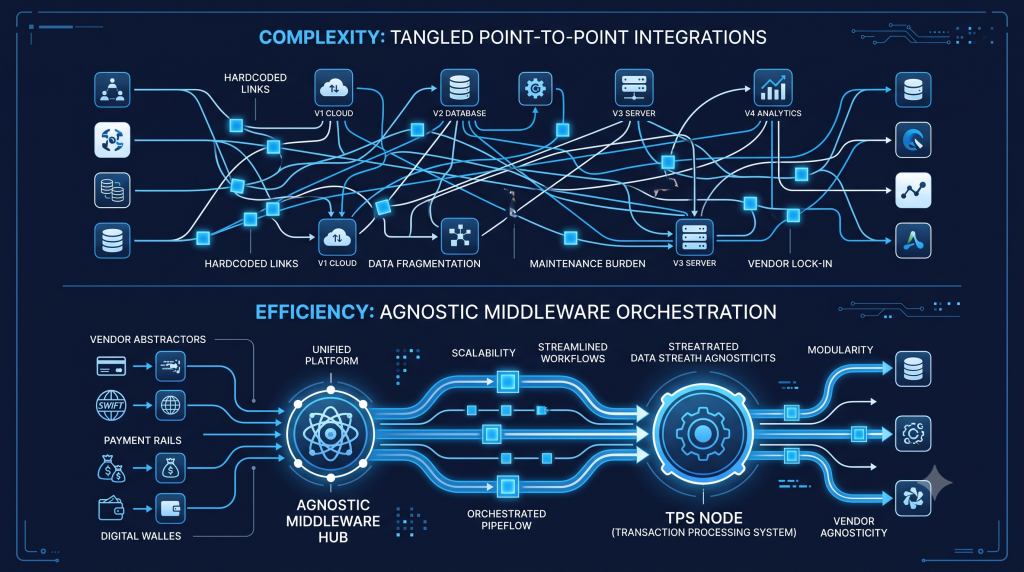
Vendor agnosticism replaces rigid point-to-point integrations with a flexible, central orchestration layer. By establishing an agnostic conduit across the Digital Property Line, data flows seamlessly between your internal TPS ledger and external providers without requiring manual re-keying or custom API development [3].
This decoupled framework unlocks true operational resilience across two critical utility functions:
🔹 Backup Abstractor Rails: When a primary search provider hits a bottle-neck, an agnostic orchestration hub allows you to route orders to alternative local abstractors instantly. Your processing team continues working entirely within their native TPS screen, while data extraction tools map the incoming search package directly into your commitment fields.
⚡ Dynamic Payment & EMD Rails: If a digital payment provider encounters network friction or compliance changes, an agnostic conduit enables you to swap underlying financial rails in the background. The consumer and escrow officer experience remains identical, ensuring funding events occur without missing closing deadlines.
By moving from static vendor connections to an orchestrated, plug-and-play environment, agency owners eliminate vendor lock-in, de-risk operational bottlenecks, and maintain complete strategic control over their technology ecosystem.
References
[1] Gartner. (2025). Enterprise Integration & Composability Study.
[2] American Land Title Association (ALTA). (2025, January). Operational Metrics Report. TitleNews Magazine, 104(1), 10–18.
[3] ShortTrack Industry Insight. (2026). The Digital Property Line Framework.