Connectivity Beyond the Core: Navigating the “Digital Property Line”
Coming off the recent industry discussions in Austin, one thing became clear: our systems are powerful, but they are hitting a digital property line.
The Boundary: Why Title Agency Workflow Automation Stops at the Property Line
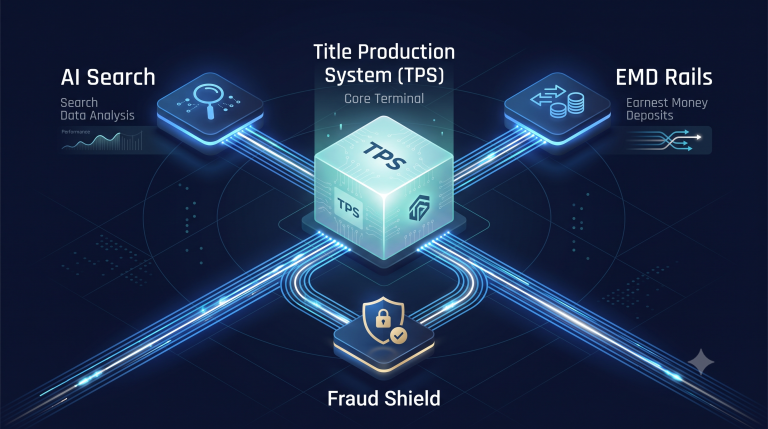
The internal efficiencies of a unified Title Production System (TPS) are undeniable. When your order entry, escrow, and closing documents live under one roof, your team can move with incredible speed inside the office. But the real estate transaction is, by its very nature, a team sport played by different organizations on different platforms.
The boundary of even the most sophisticated “all-in-one” system is the digital property line of your agency [1]. Once you need to interact with the outside world, the unified experience often breaks down. This fragmentation is a classic example of Data Silos—collections of information held by one group that are not easily accessible by others [2].
- The Lender’s Loan Origination System (LOS): Your lender isn’t logging into your TPS to check status; they are living in their LOS. Without a bridge, your team is forced to “swivel chair” data back and forth between your pristine system and their portal.
- The Underwriter Portals: Generating CPLs and policy jackets shouldn’t require leaving your workflow to log into a separate website. Even a great internal system hits a wall if it can’t achieve Syntactic Interoperability—the ability to communicate and exchange data directly with an underwriter’s core [3].
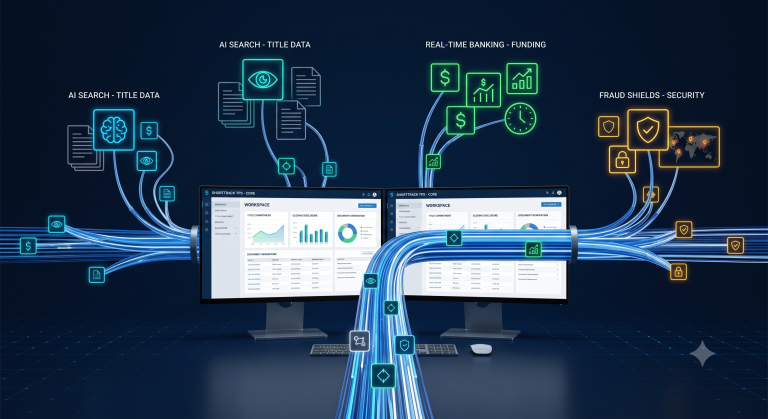
- Title Search & Document Mapping: Search is often the first place the “property line” is hit. Agents are forced to leave the TPS to access third-party portals or wait for emails. Once search documents are received, the data is often re-keyed manually. Without automated data entry and document mapping, your internal speed grinds to a halt at the very start of the file.
- The “Portal” Proliferation: The category of external vendors is huge—from eSignature platforms to non-wire payment solutions. While these tools are meant to help, each one that isn’t integrated adds another portal your team has to manage. If you have to leave your TPS to initiate a signature or confirm a payment, you aren’t gaining efficiency; you’re just managing more tabs.
- The Banking Core: Moving money is the most sensitive part of the transaction. If your internal ledger isn’t synced with the actual banking core, you are left with manual reconciliations and the risk of human error.
Efficiency within your four walls is great, but true scale comes from eliminating the friction at the handoffs.
Middleware: The Bridge Between Worlds
Middleware isn’t about adding another layer of complexity; it’s about removing the friction between the layers that already exist. If your core platform is the “Command Center” where the work gets done, ShortTrack is the high-speed transit system that brings the data in and sends the results out.
Think of it as Interoperability-as-a-Service. We act as the universal translator that allows your internal suite to speak the native languages of your external partners.
- Standardizing the Handshake: We ensure that a lender’s data—no matter how messy—arrives in your system exactly where it needs to be. You get to keep your internal workflow pristine while meeting the external requirements of your most demanding partners.
- Expanding Your Reach: By leveraging a conduit, you can offer specialized integrations (like our long-standing DocuSign partnership) that might not be native to your core system. You get the best of both worlds: a rock-solid internal foundation and an agile, connected exterior.
- Being “Easy to do Business With”: In a competitive market, the title agency that wins is the one that is the easiest to work with. When your system “just works” with a lender’s LOS or a bank’s wire system, you become an indispensable part of their workflow, not just another vendor.
The goal isn’t just to have the best software; it’s to have the most connected software.
The Next Frontier: Mastering Connectivity Beyond the Core
As the real estate tech landscape continues to evolve, the conversation is shifting. It’s no longer enough to have a unified internal experience; the challenge for title leaders is maintaining that seamlessness while navigating an increasingly complex world of external partners.
Whether you are working with a handful of specialized vendors or leveraging a massive, unified suite, your success depends on how well you can communicate outside your own four walls. The goal is to ensure that your internal speed isn’t neutralized by the friction of an external “property line.”
The takeaway is clear: The future of the industry isn’t about working harder; it’s about working together—system to system, data point to data point. By focusing on connectivity today, you aren’t just solving a technical problem; you are building the infrastructure for a truly digital transaction.
Citations & References
[1] ShortTrack Industry Insight. The Digital Property Line. (Proprietary brand metaphor for external system boundaries).
[2] TechTarget. Data Silo: Definition, Causes, and Solutions (Exploring the impact of isolated data repositories on enterprise efficiency).
[3] MDPI: Big Data and Cognitive Computing. Interoperability in the Era of Big Data (Defining syntactic interoperability as the ability of systems to exchange and use information through shared data formats).