The Vendor Paradox: Why Adding Tech Often Subtracts Efficiency
As we head to the National Settlement Services Summit (NS3) in Kansas City, the conversation has shifted away from “digitization” and toward something much more urgent: Title Automation as a critical response to a dangerous landscape.
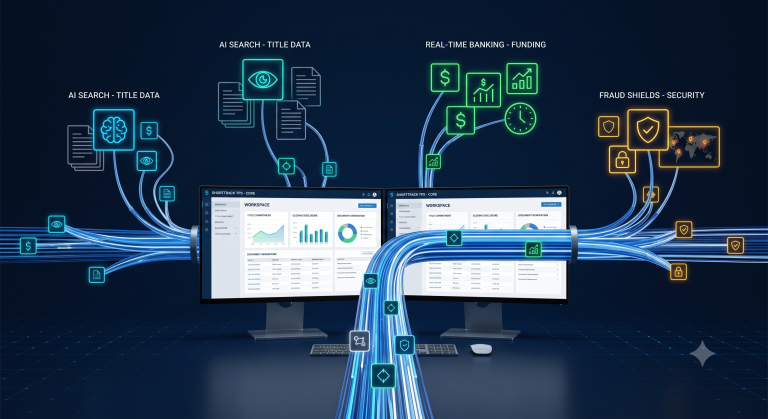
The trade show floor this year isn’t just a collection of “nice-to-have” gadgets; it is a lineup of critical responses to an increasingly complex and dangerous real estate landscape. From autonomous wire fraud prevention and real-time EMD rails to AI-assisted title search intelligence, these best-in-breed tools are designed to bolster an agency’s defenses and accelerate their output.
However, a recurring pattern is emerging across the industry. As agencies rush to implement these specialized solutions, they often stumble into the Vendor Paradox: The more high-performance, specialized tools a title agency adds to their stack, the more their overall operational velocity actually slows down.
1. The Fragmentation of the “Source of Truth”
The core of the paradox lies in the dilution of your System of Record. In a perfect world, your Title Production System (TPS) is the “Command Center.” But every time a new, highly specialized solution is added, a piece of the transaction’s “truth” is moved outside those walls.
When critical data lives in a specialized fraud portal, a separate search repository, and a standalone payment app, your “Source of Truth” becomes a scavenger hunt. Research into SaaS Sprawl shows that the average organization now manages over 305 different applications [1]. Without a unified bridge, these specialized tools become “islands of excellence” rather than a coherent workflow. This isn’t just an IT headache; it’s an architectural failure that forces your team to act as the manual “connectors” between disconnected databases.
2. The Cognitive Tax: Why Title Automation Requires Focus
While the data problem is technical, the operational cost is deeply human. It’s easy to calculate the “Swivel Chair Tax” in minutes and seconds, but the deeper cost is Cognitive Load. Every time an escrow officer jumps from their TPS to a separate browser tab to verify a wire or initiate a search, they are forcing their brain to “re-index” their task.
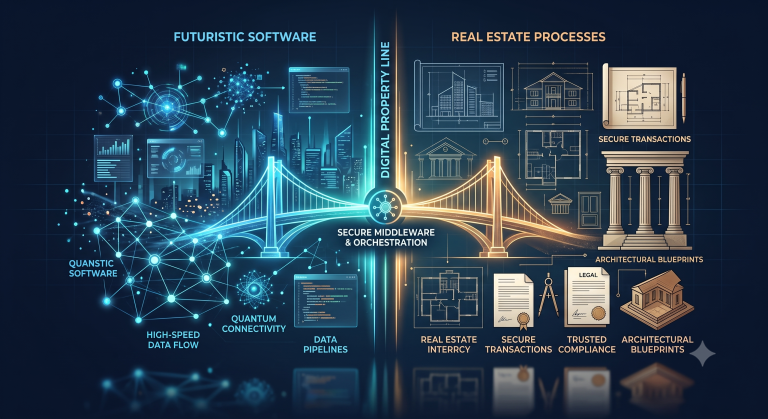
The American Psychological Association (APA) notes that these mental blocks created by shifting between tasks can cost as much as 40% of someone’s productive time [2]. In the high-stakes environment of title, this “Context Switching” isn’t just an efficiency drain—it’s a massive risk factor. Most errors don’t happen because of a lack of skill; they happen during the manual “handoff”—that fragmented moment when data is moved across the Digital Property Line [3].
3. The Security Paradox: More Portals, More Surfaces
At NS3, the focus on security will be higher than ever. Yet, there is a hidden irony: adding more security “portals” can actually increase your administrative risk.
Every additional login is a new credential for a hacker to target. Every time an employee has to download a report from one portal and upload it to another, Non-Public Personal Information (NPI) is exposed to the local “Downloads” folder or unencrypted clipboard. True security isn’t just about having the best fraud-detection tool; it’s about ensuring that sensitive data never has to leave a secure, encrypted “conduit” to get where it needs to go.
4. The AI Opportunity: Title Automation through Orchestration
We will hear a lot about AI-powered title intelligence in Kansas City. These tools are incredible—they can scan hundreds of pages of search results to highlight exceptions in seconds, or instantly analyze a complex chain of title and buyer risk profiles. But the true ROI of AI isn’t found in the insight alone; it’s found in how that information is delivered.
If an AI tool generates an insight in a vacuum, and a human has to manually type those findings back into the TPS, the value of the automation is halved. Automation is only as good as its delivery. By orchestrating these insights directly into the native workflow, we allow the AI to do what it does best: provide high-velocity intelligence without creating a new administrative burden.
How to Shop NS3 Like a “Super-Connector”
As you walk the floor in Kansas City, the most important question you can ask a vendor isn’t “What does this do?” but rather, “How does this connect?”
To avoid the Vendor Paradox, look for tools that empower your “Command Center” rather than competing with it. Ask these three strategic questions:
- Is the Handshake Bi-Directional? Does the tool just “receive” data, or can it push authenticated, mapped results back into my system of record automatically?
- Does it Minimize Context Switching? Can my team trigger this vendor’s entire service via a single menu item within their native workflow?
- Does it Bridge the Property Line? Does this tool solve a problem for my office, or does it solve a problem for the entire transaction by connecting me seamlessly to my lenders, banks, and partners?
The Bottom Line
Title Automation technology should be a force multiplier, not an administrative burden. The agencies that will thrive in the back half of 2026 are those that stop collecting “tools” and start building unified title automation ecosystems.
Before you sign that next contract at the Summit, ask yourself: Is this a bridge that connects my business, or just another island my team has to visit?
References
[1] Zylo. 175+ Unmissable SaaS Statistics for 2026 (Highlighting that the average company now manages 305+ applications and the growing complexity of software portfolios).
[2] American Psychological Association (APA). Multitasking: Changing Costs (Highlighting the “40% productivity penalty” associated with context switching between digital platforms).
[3] ShortTrack Industry Insight. The Digital Property Line. (Proprietary framework for defining the boundary between internal systems and external vendor platforms).