From ATLTA ONE to TitleCON: What Fall’s Big Conferences Reveal About 2027
Over the past month, the title industry’s fall conference circuit offered a fascinating study in contrasts. In mid-October, executive leaders gathered in Scottsdale for ALTA ONE to debate the macro forces reshaping real estate—margin compression, shifting lender expectations, and what leadership actually looks like heading into 2027. Just a few weeks later, the industry’s technologists, operators, and security leaders convened at TitleCON to tackle a very different set of questions: how to actually build, connect, and defend the modern title operation through true Title Automation without drowning staff in software bloat.
On the surface, these two rooms speak different languages. One focuses on P&Ls, market share, and client retention; the other focuses on APIs, wire security, and system architecture. Yet looking at both events side by side reveals a clear consensus: the era of buying standalone software tools to patch operational holes is officially over. As we look toward 2027, executive strategy and technical execution are finally converging around a single mandate—orchestration.
The ALTA ONE Mandate: Velocity Without Overhead
In Scottsdale, the overarching theme among agency owners and C-suite leaders was operational resilience. After navigating prolonged market headwinds, title executives are preparing for 2027 with a sharper focus on unit economics. The consensus is clear: agencies can no longer rely on hiring sprees to handle volume rebounds, nor can they afford the margin erosion caused by manual, labor-heavy workflows.
Equally prominent was the evolving expectation of lender partners. Lenders are actively consolidating their vendor panels, gravitating toward “Super-Connector” title agencies that can plug directly into their Loan Origination Systems (LOS) without creating manual friction. Industry research into digital transformation shows that organizations prioritizing end-to-end process automation achieve significantly higher operational agility and cost efficiency than peers relying on fragmented legacy workflows [1].
For executives, the message from ALTA ONE was straightforward—simply being “digitized” (having PDFs, portals, and basic software) is no longer a differentiator. Survival and growth in 2027 require frictionless operational velocity across the Digital Property Line.
The TitleCON Reality Check: The End of the “Franken-Stack”
If ALTA ONE defined what title leaders need to achieve, TitleCON exposed why so many agencies are struggling to get there. In the technical and operational tracks, CTOs and operations directors voiced a shared frustration: the industry’s “Franken-stack” problem has hit a breaking point.
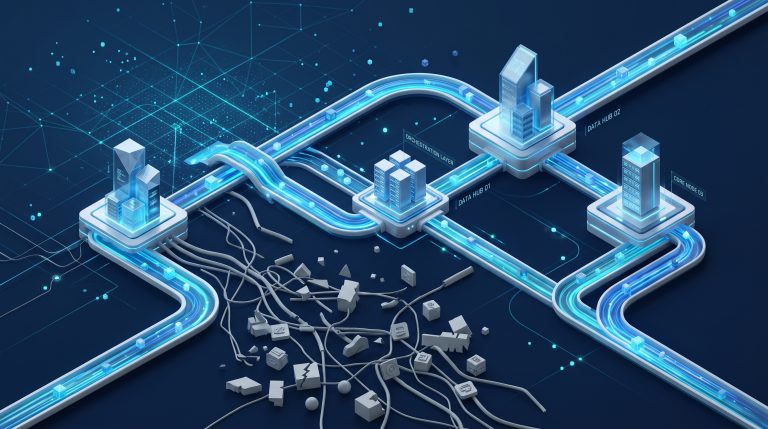
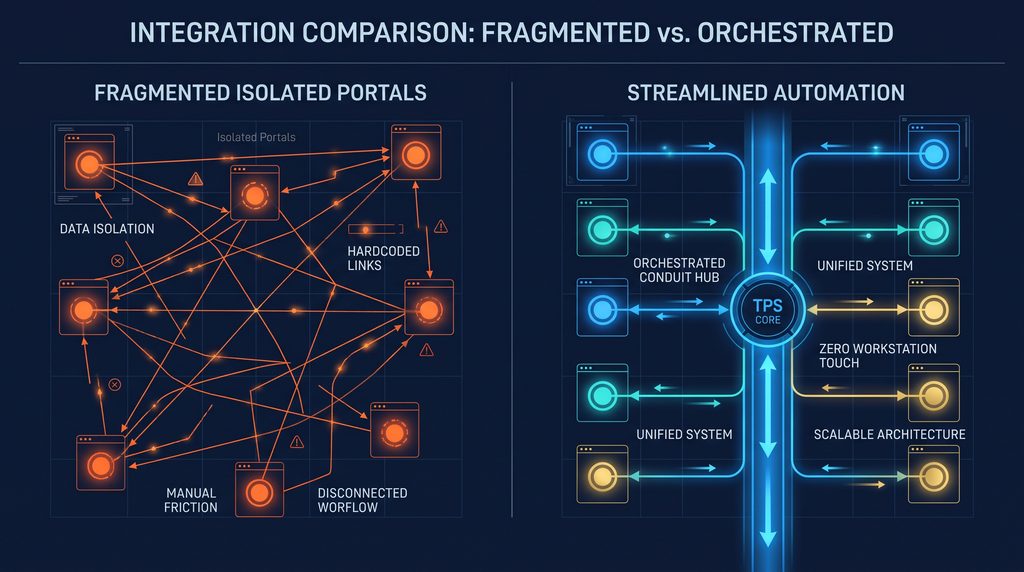
Over the last several years, agencies responded to every new challenge by purchasing another specialized point solution—one portal for digital closings, another tool for wire verification, another dashboard for curative work. Individually, these tools are Islands of Excellence. Collectively, without an orchestration layer, they create severe cognitive overload and a massive Toggle Tax. When title processors have to bounce between a dozen browser tabs and manually re-key data from one screen to another, software adoption stalls and ROI evaporates.
More urgently, TitleCON underscored that disconnected workflows are no longer just an efficiency drain—they are a critical security liability. According to the FBI’s Internet Crime Complaint Center (IC3), Business Email Compromise (BEC) and real estate wire fraud continue to account for billions in adjusted losses annually, exploiting human handoffs and unverified communication channels [2]. Relying on employees to act as “human middleware”—copying and pasting sensitive Non-Public Personal Information (NPI) via unencrypted clipboards or saving files to local Downloads folders—creates an unacceptable attack surface.
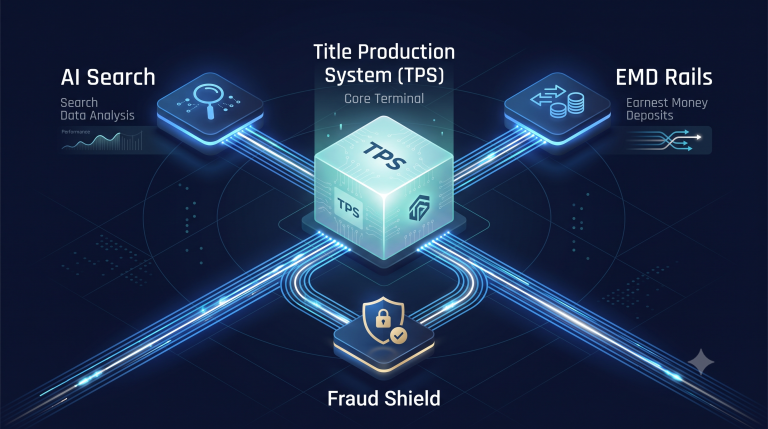
Technologists at TitleCON agreed that the path forward isn’t buying another shiny app; it is building clean, vendor-agnostic data pipelines that move information directly into the Title Production System (TPS) automatically.
Where Leadership and Tech Intersect for 2027
The biggest takeaway from this fall is that C-suite vision and IT architecture can no longer operate in silos. Solving backend integration debt is the exact mechanism that unlocks the front-end growth metrics discussed at ALTA ONE. When your TPS communicates seamlessly with lender systems, real-time Earnest Money Deposit (EMD) rails, and AI-assisted search intelligence, your team gains capacity without adding headcount, and your security posture hardens by default.
As leadership teams finalize their budgets and strategic plans for the new year, bridging this gap with Title Automation comes down to asking three honest questions:
- Where are our employees still acting as human middleware? Identify every workflow where staff manually transfer data between two systems that should be talking to each other via API.
- Which software contracts are creating toggle fatigue instead of measurable ROI? Audit your stack for overlapping portals and shelfware that add steps rather than removing them.
- Is our current architecture built to scale if volume surges in 2027? Ensure your core workflows are orchestrated enough to absorb a 30% or 50% spike in orders without breaking your team.
Looking Ahead: Moving from Digitized to Orchestrated
The title agencies that win in 2027 won’t be the ones that signed the most software contracts in 2026. They will be the ones that orchestrated the specialized tools they already have into a single, cohesive Title Automation ecosystem.
Next month, we’re releasing our flagship year-end research report, The 2027 Title Ecosystem Benchmark: From Digitized to Orchestrated, designed to help C-suite executives and operations leaders evaluate their current stack and build a practical architectural roadmap for the year ahead. Stay tuned—or reach out to our team today to start auditing where hidden friction is holding your operation back.
References
- McKinsey & Company. (2025). The State of AI and Digital Transformation in Financial Services. https://www.mckinsey.com/industries/financial-services/our-insights
- Federal Bureau of Investigation (FBI). (2025). Internet Crime Report: Real Estate & Business Email Compromise Trends. https://www.ic3.gov/AnnualReport/Reports