Scalability is Connectivity: Handling Volume Spikes Without the Headcount Spike
When real estate transaction volume bounces back, achieving true operational scale relies entirely on modern title automation rather than adding margin-killing payroll overhead. Historically, title agency leadership met refi booms or spring market surges by scrambling to hire, train, and onboard armies of escrow processors. But in today’s high-velocity market, relying on manual staffing to scale operations introduces severe friction, burnout, and error rates. True scalability is not a hiring equation—it is a connectivity solution.
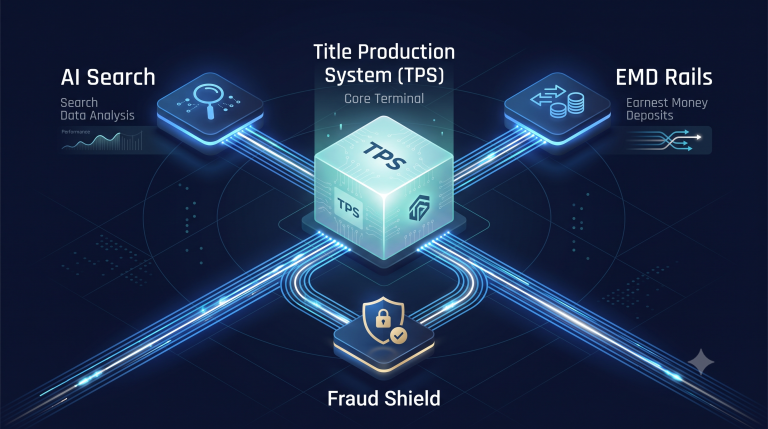
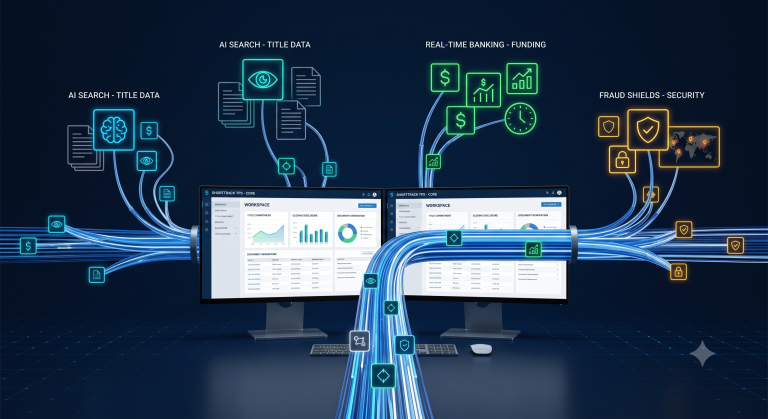
By replacing manual data re-keying with agnostic middleware conduits, forward-thinking title agencies transform their operations into elastic, high-capacity ecosystems capable of absorbing massive volume surges without adding payroll overhead.
The Hiring Trap: Why Staffing Up Destroys Margin Velocity
The traditional title agency growth model is inherently flawed. When transaction volume rises, agencies add headcount. When volume contracts, they are forced into painful lay-off cycles that erode culture and drain institutional knowledge.
This reactive hiring cycle creates severe operational vulnerabilities:
- The Onboarding Lag: It takes months for a new escrow assistant to master local title nuances, specific Title Production System (TPS) layouts, and lender-specific requirements. By the time new hires reach full productivity, the peak volume spike may already be receding.
- The Margin Squeeze: Fixed operational overhead expands permanently to solve a temporary volume surge, gutting agency profitability as transaction margins tighten.
- The Error Escalation Rate: Rushed, newly onboarded staff manually transferring data between disconnected systems leads to a dramatic spike in missing signatures, inaccurate legal descriptions, and funding delays.
According to ALTA operational benchmarks, manual processing during peak volume periods increases file rework rates significantly, turning revenue opportunities into administrative write-offs [1]. Adding bodies to a broken, fragmented workflow does not create scale—it simply scales chaos.
Breaking the Human Middleware Bottleneck
The real reason title agencies struggle to handle volume surges isn’t a lack of human effort; it is the reliance on staff to function as “human middleware.”
In a disconnected agency, every file requires an escrow officer to swivel between multiple isolated platforms—copying contract data from transaction portals, entering loan details into the TPS, requesting search packages from third-party vendors, uploading documents into underwriter portals, and verifying wire instructions with banking cores.
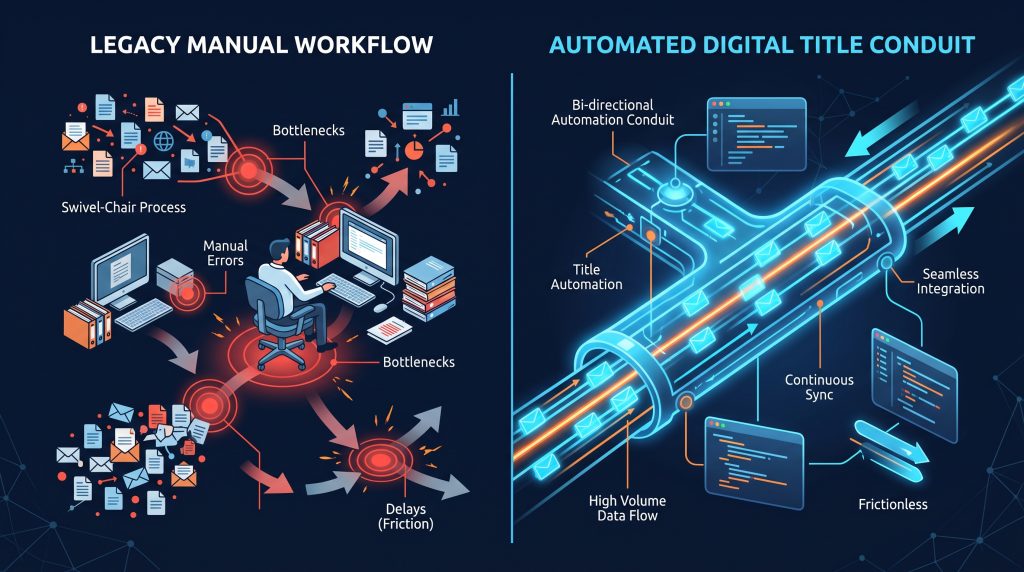
This manual “bucket brigade” imposes a brutal Swivel Chair Tax on operations. When file volume doubles, the number of manual logins, context switches, and keystrokes doubles with it, rapidly pushing processing teams past their cognitive capacity limits.
When software applications operate in isolated silos, employees spend up to 40% of their daily bandwidth simply moving data from point A to point B rather than exercising their specialized title expertise. To scale sustainably, agencies must remove human processors from the data transit layer entirely.
Orchestration vs. Integration: Building the Elastic Pipeline
To achieve true operational elasticity, title leaders must move beyond standard point-to-point software integrations and embrace true workflow orchestration.
Point-to-point integrations are rigid, hardcoded pipelines that connect two specific applications. When a vendor changes their API or an agency upgrades its core TPS, those brittle connections break.
Agnostic middleware acts as a central digital nervous system, orchestrating data movement across your entire technology perimeter without disrupting your core system of record:
- Automated Order Entry at the Digital Property Line
Order requests, sales contracts, and lender instructions cross the Digital Property Line and flow directly into your core TPS layout without human intervention. Field mapping, property details, and buyer/seller data populate automatically, allowing files to be opened in seconds rather than minutes. - Bi-Directional Vendor Dispatch
Search orders, CPL generation, policy jacket requests, and tax documentation are triggered automatically based on milestone events within the TPS. Results, commitment data, and final PDF assets return directly into the file ledger without processors ever logging into an external portal. - Synchronized Financial & Closing Rails
Earnest money deposit (EMD) confirmations, real-time wire fraud verification checks, and eSignature status updates sync continuously between banking cores, closing portals, and the primary ledger.
By deploying middleware to handle data transit, volume surges pass through software conduits rather than human workstations [2]. Your processing team remains focused exclusively on exception handling, title clearance, and client relationship management.
The Invisible Scalability Advantage
The most scalable title operation is one where data transit is completely invisible. When market volume doubles, your staff’s daily routine shouldn’t change. Escrow officers shouldn’t be logging into extra vendor portals, working late nights re-keying contract amendments, or rushing through manual verification checks.
Agencies that replace manual data entry with agnostic orchestration unlock an unassailable competitive edge:
- Instant Capacity Expansion: Absorb a 100% surge in file volume immediately without increasing operational headcount or overtime expenditures.
- Compressed Turn Times: Deliver clear-to-close files to lender partners days faster than competitors constrained by manual processing bottlenecks.
- Audit-Proof Compliance: Maintain strict Non-Public Personal Information (NPI) perimeters by keeping data encrypted inside digital pipelines rather than sitting in unencrypted desktop download folders.
Stop meeting volume spikes with headcount spikes. By unifying your specialized tools into an orchestrated title automation ecosystem, ShortTrack empowers your agency to turn market volatility into long-term operational margin.
References
- American Land Title Association (ALTA). (2025). Operational Metrics & Scalability Report. https://www.alta.org/research
- McKinsey & Company. (2025). The Automation Imperative in Financial Services. https://www.mckinsey.com/industries/financial-services/our-insights