
Shadow IT vs. Connected IT: Bringing Workflow Workarounds into the Light
Every title agency owner likes to believe that their written standard operating procedures (SOPs) are the absolute law of the land. We invest heavily in our Title Production Systems (TPS), map out explicit user permissions, and mandate standardized paths for data entry. However, achieving true title automation requires more than just establishing clean, uniform, and secure internal workflows; it requires looking at what happens when those systems hit an operational bottleneck.
If you step onto your processing floor on any given Thursday afternoon, you will likely discover a parallel operational universe running right under your nose..
You’ll see an escrow assistant using a personal web-browser plugin to summarize 80-page text restrictions. You’ll find a processor tracking critical file milestones in a private, unmanaged cloud spreadsheet because the primary system requires “too many clicks.” You’ll find unapproved group chats being used to coordinate wire releases with mobile notaries across town.
In enterprise software engineering, this is known as Shadow IT—the deployment of unsanctioned applications, cloud utilities, or software workarounds without explicit organizational oversight.
In the title industry, it is a silent epidemic. It represents a fascinating operational crossroads: Shadow IT is simultaneously a brilliant demonstration of employee ingenuity and a catastrophic breakdown of your regulatory compliance perimeter. The cure isn’t more severe corporate mandates; the cure is architectural title automation.
The Root of the Shadow: Why Good People Build Rogue Systems
Let’s establish an essential premise as a supportive operational peer: your staff does not deploy rogue software out of malice. Escrow officers and title clerks are profoundly dedicated to a single, overriding metric—clearing the file and getting to the closing table on time.
When your official technology stack is clunky, slow, or fragmented into separate “Islands of Excellence,” it creates an operational deficit. Employees hit the Digital Property Line [1], realize their tools don’t talk to each other, and suffer under what we call the “Swivel Chair Tax”—manually copying and verifying information across unlinked screens.
To survive the day, they create workarounds. This cultural pivot is a massive macroeconomic trend. According to the 2026 Retool State of Shadow IT & Automation Report, this behavior is driven directly by operational necessity:
A striking 60% of senior managers and operational builders admit to deploying or building software solutions completely outside of official IT oversight within the past 12 months [2]. When surveyed about their motivations, 31% cited a need for operational speed, while 25% stated that official corporate tools failed to meet their day-to-day workflow demands [2].
When your staff faces unmet technical needs, they don’t wait for a corporate committee. They find an app, sign up with a free trial, and keep moving.
The Heavy Cost of Software Sprawl
The immediate consequence of unchecked workarounds is severe platform fragmentation. As SaaS management research from Zylo demonstrates, the average enterprise now balances a portfolio of over 305 separate applications [3]. When a significant percentage of those applications are unmanaged “Shadow” platforms, your operational data becomes an untamable scavenger hunt.
This fragmentation carries a direct human toll. When an employee spends their afternoon bouncing between your official TPS, a rogue tracking spreadsheet, a standalone vendor portal, and a personal text assistant, their brain undergoes constant cognitive disruption.
Research conducted by the American Psychological Association (APA) reveals that this frantic context switching hits your staff with a hidden 40% productivity penalty [4].
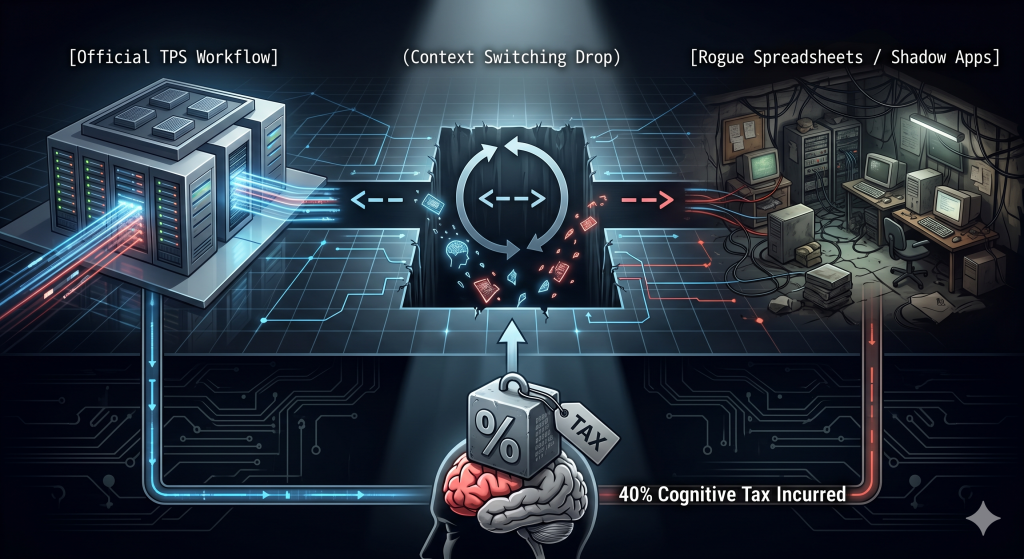
You aren’t just losing operational velocity; you are actively draining the cognitive bandwidth of your most experienced title experts by turning them into human data-routing conduits.
The Compliance Blind Spot: Data in the Dark
Beyond lost time, Shadow IT introduces an existential security threat to the title perimeter.
By law, our industry must maintain an absolute chain of custody over Non-Public Personal Information (NPI). When an employee copies a buyer’s wire details or an unredacted closing statement into an unmanaged, free online document utility or an unauthorized messaging channel, that data immediately leaves your secure environment.
Your IT department cannot protect, patch, or audit data surfaces it does not know exist. A single unauthorized browser extension or unencrypted personal cloud account can open a backdoor into your endpoint network, leaving your agency completely exposed to catastrophic wire fraud intercepts, regulatory audit failures, and data breaches.
Connected IT: Transforming Silos into Synapses
How do we bring these workflow workarounds out of the dark? The traditional executive response is to lock down the network, block external websites, and issue strict disciplinary warnings.
But hiding the tools doesn’t eliminate the friction. If the underlying bottleneck remains, your staff will simply invent even cleverer, harder-to-detect workarounds to get their files closed.
The structural solution is to replace Shadow IT with Connected IT through automated orchestration.
Instead of forcing your staff to seek out rogue utilities to bridge operational gaps, you must provide a secure, native, agnostic conduit that does the heavy lifting for them. By embedding an orchestration layer like ShortTrack directly into your core workflow, you eliminate the very friction that breeds Shadow IT.
When your central TPS communicates bi-directionally with external vendors, lenders, and banking cores in real-time, the need for rogue spreadsheets evaporates. The data flows seamlessly across the Digital Property Line [1], directly into the native screens your processors already live in.
Channeling Human Ingenuity
Your employees’ desire to find faster, better ways to clear titles is your agency’s greatest asset. Don’t suppress that energy with rigid technology silos.
By deploying true title automation orchestration, you channel that operational creativity into a secure, unified digital pipeline. You protect your compliance perimeter, eliminate the 40% context-switching tax [4], and finally turn your disconnected workarounds into a high-speed, fully synchronized operational ecosystem.
References
- [1] ShortTrack Industry Insight. The Digital Property Line Framework. (Defining the operational and security perimeter between internal title production systems and external transaction environments).
- [2] Retool. The Build vs. Buy Shift: AI, Shadow IT, and the SaaS Replacement Era Report 2026. (Uncovering that 60% of senior managers and operations leaders deploy unsanctioned tools due to operational speed bottlenecks and unmet software needs).
- [3] Zylo. Enterprise SaaS Management Index. (Tracking the continuous growth of corporate software footprints, showing the average enterprise footprint exceeding 305+ standalone applications).
- [4] American Psychological Association (APA). Multitasking: Changing Costs. (Documenting the definitive 40% cognitive and productive time penalty associated with platform context switching and fragmented digital environments).